GAIL Programme · Baseline Assessment

What 118 women microentrepreneurs in Nairobi & Eldoret told a voice AI.

A pre-intervention baseline from the Gender & AI Livelihoods programme — gathered entirely over standard phone calls, in participants' own words. No smartphone, no internet, no enumerators.

Location  Nairobi & Eldoret, Kenya Fieldwork  May 2026 Partners  Shortlist Futures · Inkomoko · Gates Foundation
Why this programme exists

A business coach in every pocket — even where there's no internet.

In the markets, kiosks and tailoring shops of Nairobi and Eldoret, women are running real businesses against real odds. They know their trade. What they rarely get is someone in their corner week after week — a coach to think through a pricing decision, a slow month, a chance to grow.

Training exists, and it helps. But it fades. The advice that lands in a workshop rarely survives the rush of the next trading day, and the digital tools meant to fill the gap assume a smartphone, an app, a data bundle — things much of this population doesn't have.

So we asked a simple question: what if every woman could have a coach she calls from the phone already in her hand?

That's the Gender & AI Livelihoods programme — funded by the Gates Foundation, led by Shortlist Futures, and delivered on the ground with Inkomoko, one of East Africa's most established entrepreneur-support organisations. Fortell built the voice AI that makes it reach. This report is where that story begins: who these women are, before the coaching.

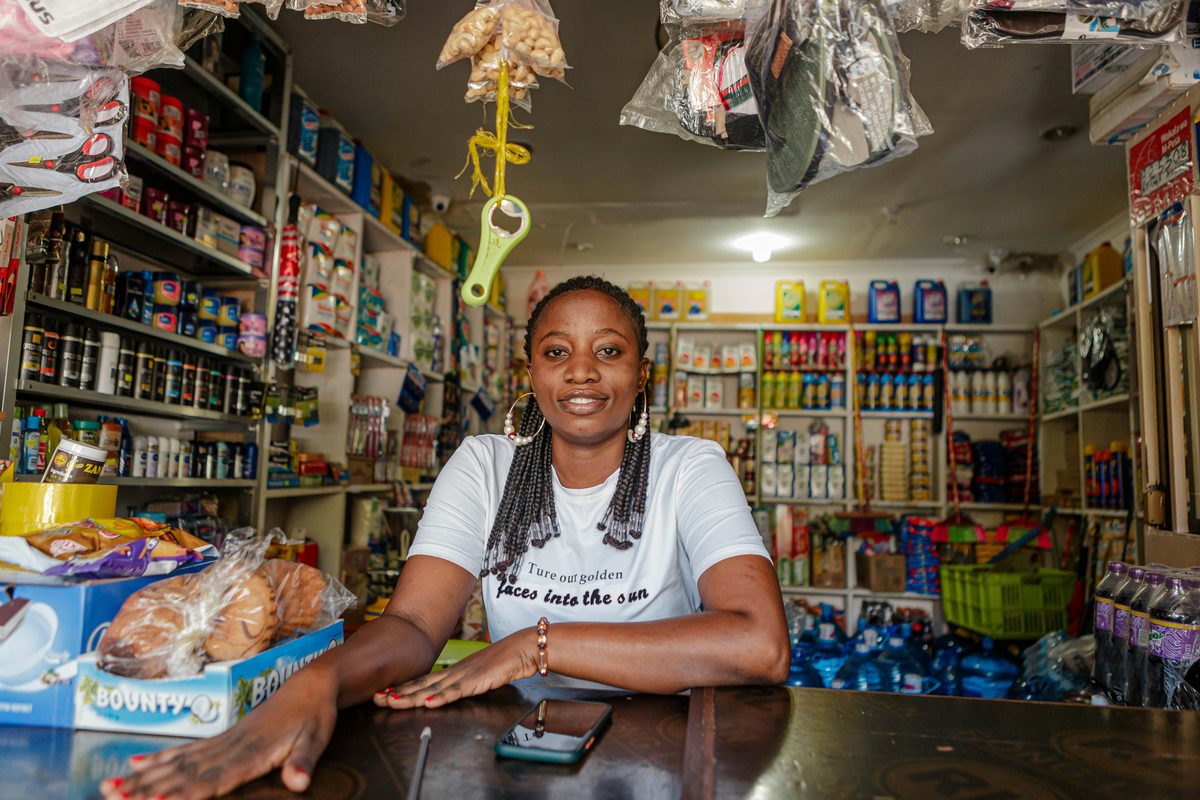
A market trader at her stall in Nairobi
A woman running her well-stocked shop
A woman arranging colourful printed fabrics at her stall
0
surveys completed across the fieldwork window
0
retained for analysis after quality review
12:43
average call minutes per interview
0
calls scored negative, of 120 assessed
Our methodology

The VoicePrint Framework

One engagement, three layers of evidence — what happened, what changed, and what it meant. This baseline is built across all three.

01Profile — who was reached

An established, hard-to-reach cohort — reached on a basic phone.

The 118 women are working-age, experienced entrepreneurs: Kenyan host-community members alongside urban-based refugees from Somalia, Congo, Ethiopia, Rwanda and Burundi, spanning no formal schooling to university degrees.

Nearly half live in peri-urban or rural areas with limited business support — exactly the population most digital tools leave out. A single, language-accessible voice instrument reached all of them.

Who was reached
94%
actively running a business
47%
peri-urban or rural
Trading 3+ years77%
Married or partnered66%
Identified as female99%
02Outcomes — the baseline we'll measure against
Financial behaviour at baseline
Track business costs92%
Save money86%
Have a financial safety net68%
Cite capital as the main barrier50%

The starting line for coaching — captured indicator by indicator.

Layer 02 maps directly to the programme's reporting requirements: income, financial behaviour, confidence, growth barriers and decision-making, each collected on its own valid-response base.

The picture is a capable but capital-constrained cohort: most track costs and save, yet 87% find earnings only sometimes or rarely sufficient, and income smoothing is the clear coaching target.

At baseline these are the counterfactual — the numbers we'll measure change against when the same instrument runs at endline.

03Voice — what it meant

Beyond the indicators, in their own words.

Every call closed with open questions. The answers are where the data becomes a person — the reason for a number, the next step they already know they need to take.

And because the survey itself was a spoken conversation, the Voice layer isn't only a transcript — it's how the cohort sounded.

"I need more money to earn more money."
— on the capital barrier
"I find myself in a chama — we contribute a little day by day, and when I get it, I pay my bills."
— on saving through a chama
"We buy stock heavily and we save, for the coming month."
— on planning ahead
"If I could get more money, I can expand my business."
— on growth ambition
What happens next

From a baseline to behaviour change — the coaching is live.

A snapshot doesn't change a business. So from June 2026, the same women are receiving weekly coaching calls from the AI agent — each one personalised from their own profile, sector and baseline answers.

The curriculum is Inkomoko's, proven on the ground: pricing, cost control, customer management, record-keeping and market access. What the voice AI adds is the part training usually can't — showing up every week to turn knowing into doing.

Each call runs a simple loop, the engine behind real behaviour change:

Try something
Reflect on what happened
Adjust & commit again
Coaching calls running now · June–August 2026
A produce stall in a Kenyan market
The skills — from Inkomoko

What good business looks like

  • Pricing that's built on cost, not guesswork
  • Controlling costs and cutting waste
  • Winning and keeping customers
  • Simple record-keeping that sticks
  • Reaching new markets
The behaviour — Personal Initiative

Acting like an owner, every week

  • Looking ahead and planning before the slow season
  • Spotting opportunities and acting on them
  • Persisting after a setback
  • Trying small experiments and learning from them
"What small experiment could you try this week with your prices?"
What's next

This is the baseline. The story finishes at endline.

The same VoicePrint instrument runs again after coaching — and we'll publish what changed, layer by layer. Leave your email and we'll send it when it lands.